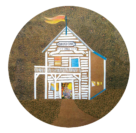
The hall was built in 1850, eight years after St. Mark’s and six after St. Matthew’s, in a village that had opened its first school in 1837 — thirty students by 1840, four of them Rinards, two Teals, a Pence, a Wagner, two Clattenburgs, and the rest of them Conrads.
For most of its life the building stood closer to the road than it does now, and when the road was paved in the early sixties the whole thing was picked up and set back from it. It has been cut in half and had a new section built into the middle. It has been a polling station, a stop on the bookmobile’s run, and a supper hall more times than anyone has counted. In 1973, two weeks after a fire came through Cherry Hill and did not stop there, Audrey Bowers called a meeting in this room, which led to founding the United Communities Fire Department.
In 1992 the trustees brought in an engineer, because the village was getting older and the kitchen was up a flight of stairs. He came back with three options — extend the front by twenty-eight feet, extend it and re-truss the roof, or take the hall down and build something new — and at a public meeting the village turned down all three. What they wanted was this building with its vintage feel intact. That was not a vote against making the hall work for everybody. It was a vote that whatever came next had to be done without losing the place, which the Association has been working on ever since.
Over the following decades the Association developed that principle into a working brief: a warm and welcoming hall, open and accessible to all ages and abilities, used year-round, with a smaller carbon footprint. It brought in accessibility consultants to audit the building and tell it the truth about itself. Then it started writing grants — insulation first, then a furnace, then windows, and finally the difficult part, an entrance and a washroom that anyone can use. In 2022 Andrew Kimball at Patterson Law spent many pro-bono hours merging two property numbers into one so that the Association could qualify for a line of credit at the LaHave River Credit Union. Money came from Ottawa, from the province, from MODL, and from a great many people in the village. The builders started in April 2022 and finished on time and on budget, in the middle of a pandemic.
The Broad Cove Community Association
The Broad Cove Community Association is a volunteer-led, not-for-profit organization and a registered charity, dedicated to strengthening community connections and caring for Broad Cove Hall and the surrounding community. The hall is the heart of that work — keeping it affordable and welcoming, and open for celebrations, meetings, programs, and private rentals.
Through the year the Association puts on community meals and coffee mornings, music and cultural events, fitness programs, markets, fundraisers, educational evenings, and the community fun run. It also makes room for residents to share their own skills, interests and ideas through volunteer-led programs, which is how a good many of these began.
Beyond the hall, the Association is a steward of Broad Cove Beach and the beach lands beside it, working to protect the area’s natural environment while supporting responsible public access. That one took some doing. Residents first raised concerns about the common lands in 2002, and it was 2024 before MODL agreed to expropriate the land above the beach so that it could be held publicly and managed as a conservation area.
The work is made possible by volunteers, community members, local partners, grants, fundraising, and hall rentals. When you rent the hall, that is where your rental goes.